
TRADITIONAL 15 omnifill
Jointing mortars

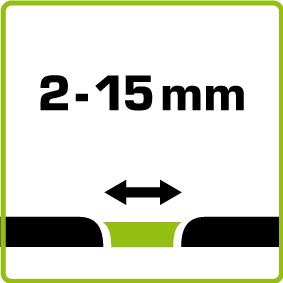
Water-resistant grout for joints from 2 mm to 15 mm wide
Main product properties
- Can be used in the traditional manner (by adding powder) and by machine.
- Wear and abrasion-resistant.
- Can be used universally for ceramic floor tiles and most types of natural stone.
- Suitable for underfloor heating.
- Walls and floors.
- Indoor and outdoor.
- Classification compliant with EN-13888: CG2W A.

Applications
For grouting every possible type of ceramic floor tiles and most types of natural stone. Designed for use on the floor. A water-resistant grout used for both indoor and outdoor applications, for walls and floors. Specially suited to porous natural stone (fewer cleaning problems). Enhanced resistance to wear and abrasions. The maximum joint width is 15 mm. Not suitable for applying tiles to sheeting materials. Examples of application locations include living and office spaces and areas in healthcare situations.


Getting started with TRADITIONAL 15 omnifill


Certificates and documents
Download the documents available from this specific product here.
Can't find the right certificate?
Contact usVideos
Here you will find the videos available for this specific product. If you didn't find what you were looking for, check out our YouTube channel.


Let us help you out
What different types of glue are there?
There are 3 types of glue, each with their own characteristic properties. They are all standardized within the European standard EN 12004.
The specific properties of a product say nothing about what you can do with it. Each manufacturer determines this individually in the technical data sheet. So always follow the regulations via our advice module.
- Cement-based powder tile adhesive (C)
- Dispersion glue (D)
- Reaction glue (R)
Read more about the different types of tile adhesive on the next page.
Which glue comb is best to use?
The choice of the right teeth depends on a number of factors;
Tip: By regularly removing a tile from the adhesive bed, you can see what the adhesive contact surface looks like and whether this is sufficient.
- the type of tile adhesive (paste or powder),
- the 'buttering-floating' method is used, and
- the application (wall or floor),
- the flatness of the substrate and the flatness of the tile.
For large format tiles >60x60 cm. It is in any case important that the surface is flat. If you need to eliminate large level differences in the surface, you can first level the surface, or you can use a thick-bed mortar with a round-toothed adhesive comb.
Read some guidelines regarding glue combs on the next page.